About the Journal
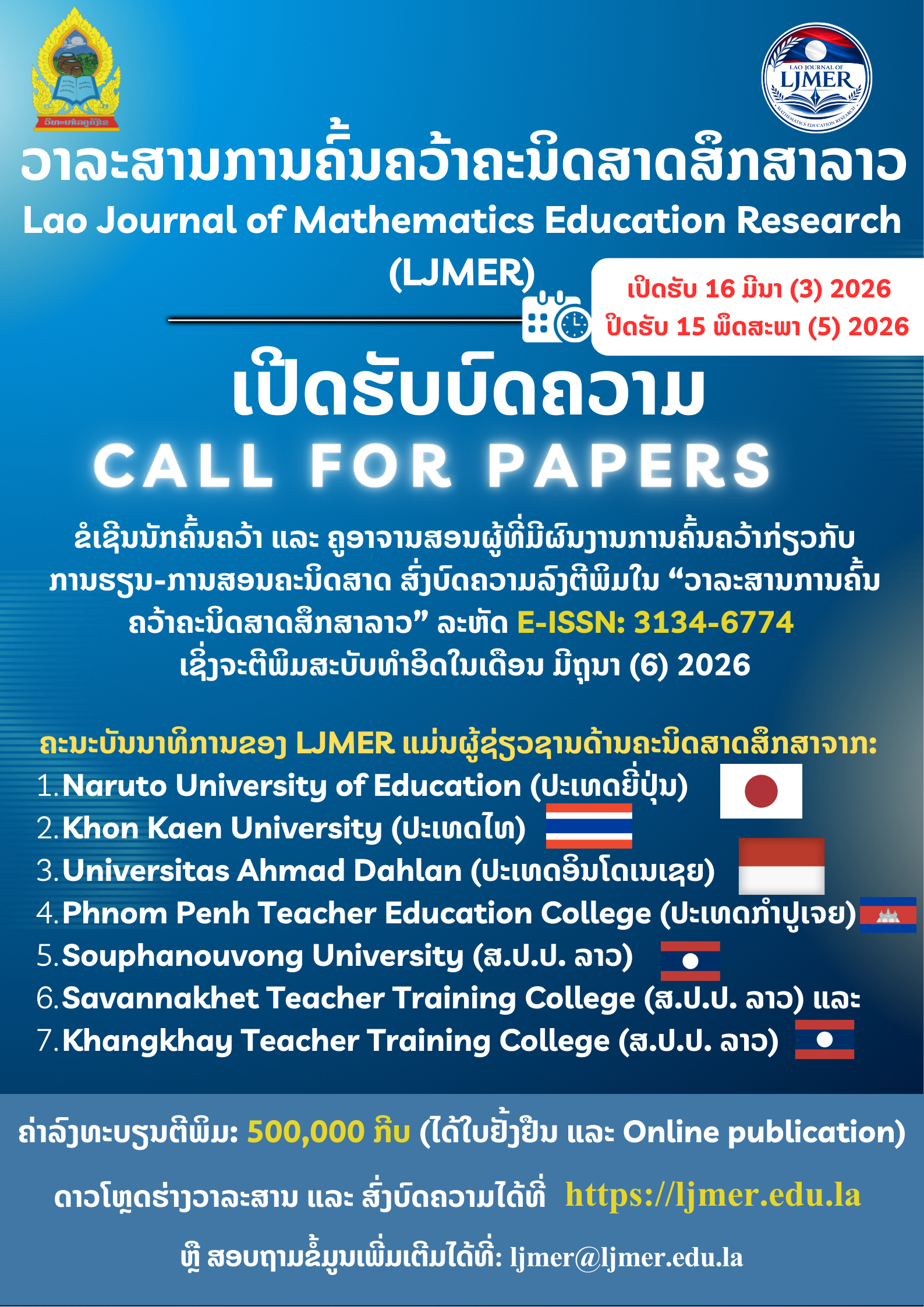
The Lao Journal of Mathematics Education Research (LJMER) is a peer-reviewed academic journal dedicated to advancing research, theory, and practice in mathematics education at all levels of education. The journal provides a scholarly platform for researchers, educators, teacher trainers, and policymakers to disseminate original research findings and innovative practices related to the teaching and learning of mathematics. LJMER welcomes empirical, theoretical, and methodological studies that address mathematics education in local, regional, and international contexts, with a particular focus on the Lao PDR or Southeast Asia.
The scope of the journal includes, but is not limited to, the following areas: Teaching and Learning of Mathematics, Mathematics Curriculum and Assessment, Teacher Education and Professional Development, Innovative and Contemporary Approaches in Mathematics Education, Psychology and Sociology of Mathematics Education
LJMER publishes original research articles, review papers, and scholarly discussions that contribute to improving the quality of mathematics education and supporting evidence-based educational decision-making.
LJMER accepts online submissions only and is published three times a year (June, October, and February) with a publication fee of 500,000 KIP or $25 USD. Please register the publication fee at
-
Bank Name: Lao Development Bank
-
Bank Account Name: The Journal of Khangkhay TTC
-
Bank Account Number: 0300900010001881
1. Transparent Peer-Review Process
The Lao Journal of Mathematics Education Research (LJMER) applies a double-blind peer-review process to ensure objectivity, fairness, and academic quality.
-
The Editorial Board initially screens all submitted manuscripts for scope, originality, and basic quality.
-
Manuscripts that pass the initial screening are reviewed by at least two independent experts in mathematics education.
-
Reviewers and authors remain anonymous throughout the review process.
-
Editorial decisions are based on reviewers’ comments, academic merit, relevance, and originality.
-
Authors are required to respond to reviewers’ comments and revise their manuscripts accordingly before final acceptance.
2. Stated Review Timeline
LJMER is committed to an efficient and transparent review process with the following indicative timeline:
-
Initial editorial screening: within 7–10 days
-
Peer review process: 4–6 weeks
-
Author revision: 2–4 weeks (depending on revision level)
-
Final decision: within 2 weeks after revised submission
The average time from submission to publication is approximately 8–12 weeks.
3. Ethics Statement (Aligned with COPE)
LJMER follows the Committee on Publication Ethics (COPE) guidelines and best practices in scholarly publishing.
The journal is committed to maintaining high ethical standards in research, authorship, peer review, and editorial decision-making.
All parties involved in the publication process—authors, reviewers, editors, and publishers—are expected to adhere to COPE’s ethical principles.
4. Publication Malpractice Policy
LJMER takes all forms of publication malpractice seriously, including but not limited to:
-
Plagiarism
-
Data fabrication or falsification
-
Duplicate or redundant publication
-
Improper authorship attribution
-
Undisclosed conflicts of interest
If malpractice is suspected, the Editorial Board will investigate the case in accordance with COPE procedures. Appropriate actions may include rejection, correction, retraction, or notification of authors’ institutions.
5. Plagiarism Policy
-
All manuscripts submitted to LJMER are screened using plagiarism detection software.
-
Manuscripts with significant plagiarism, including self-plagiarism, will be rejected.
-
Proper citation and acknowledgment of all sources are mandatory.
-
A similarity index exceeding the journal’s acceptable threshold (normally not more than 15–20%, excluding references) may result in rejection or revision requests.
6. Retractions and Corrections
LJMER will issue corrections, expressions of concern, or retractions when necessary to maintain the integrity of the scholarly record.
Retractions may occur in cases of:
-
Proven plagiarism
-
Serious methodological errors
-
Ethical violations
-
Research misconduct
Retraction notices will be clearly identified and linked to the original article.
7. Conflicts of Interest
All authors, reviewers, and editors must disclose any financial, professional, or personal conflicts of interest that could influence the research or its evaluation.
-
Authors must declare conflicts of interest at the time of submission.
-
Reviewers must decline review if a conflict exists.
-
Editors with conflicts will recuse themselves from the editorial decision process.
8. Authorship Policy
Authorship should be limited to individuals who have made significant intellectual contributions to the research, including:
-
Study conception and design
-
Data collection, analysis, or interpretation
-
Manuscript drafting or critical revision
All listed authors must:
-
Approve the final version of the manuscript
-
Agree to its submission and publication
-
Take responsibility for the content of the work
Any changes to authorship after submission require written consent from all authors.
9. Ethical Responsibilities of Authors
Authors submitting manuscripts to LJMER are expected to adhere to the following ethical standards:
-
Submit only original work that has not been published previously and is not under consideration elsewhere.
-
Properly acknowledge and cite all sources used in the research.
-
Ensure that data presented are accurate, honest, and reproducible, and that no fabrication or falsification has occurred.
-
Avoid plagiarism, self-plagiarism, and redundant publication.
-
Clearly identify all individuals who meet the criteria for authorship and obtain approval from all co-authors prior to submission.
-
Disclose any conflicts of interest that may influence the research or its interpretation.
-
Notify the editor promptly if a significant error is discovered after publication and cooperate in issuing corrections or retractions.
10. Ethical Responsibilities of Editors
Editors of LJMER are responsible for maintaining the integrity of the journal and ensuring a fair and transparent editorial process:
-
Make editorial decisions based solely on academic merit, originality, clarity, and relevance to the journal’s scope.
-
Ensure that all manuscripts undergo a double-blind peer-review process.
-
Maintain confidentiality of submitted manuscripts and reviewer identities.
-
Avoid conflicts of interest and recuse themselves from handling manuscripts when conflicts exist.
-
Take appropriate action in cases of suspected misconduct, following COPE flowcharts and guidelines.
-
Publish corrections, retractions, or expressions of concern when necessary to preserve the scholarly record.
11. Ethical Responsibilities of Reviewers
Reviewers play a critical role in maintaining academic quality and are expected to:
-
Conduct reviews objectively, constructively, and within the agreed timeframe.
-
Maintain confidentiality of manuscripts and not use unpublished material for personal advantage.
-
Identify relevant published work that has not been cited by the authors.
-
Report suspected ethical issues, including plagiarism or data manipulation, to the editor.
-
Declare conflicts of interest and decline reviews when such conflicts exist.